
As promised, here is Alice’s reading of another disabled Bond villain, Dr. Julius No.
In typical “me” style, I planned this piece of bonus content before actually going ahead and doing
any of the research, so as I sit down to write the damn thing I find myself still a little baffled by what
I found whilst reading and watching Dr. No.

Before today I hadn’t read a single Bond book and I don’t think I’d seen more than a few clips of any
of the films pre-Brosnan. Despite my father being a big fan of Bond, I never understood the appeal.
Having read the book and watched the film I have to say I still don’t get it.
I intended this piece to be a short Fabled to kick off the Disability Technology series, I figured I’ll
write about Dr. No as the History Lesson over the on the main audio feed is all about historical
prostethics and mobility aids – and for those not in the “no” the titular antagonist in Dr. No has
prostethic metal hands. Perfect, I thought, ‘with all the over the top science and and far fetched
technology in Bond I bet there’ll be tonnes to write about’. Frankly, I was wrong – but lets drag this
out anyway and see where it goes!
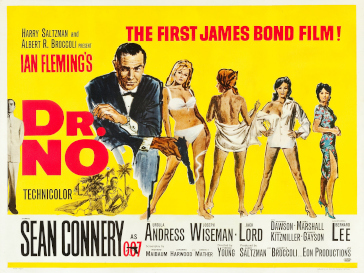
The novel Dr. No was released in 1958 while Jamaica was still under British rule and, although I’m
sure that doesn’t account for all of the racism in the book, it will certainly have informed some of it.
The way people of colour are described in the book, both native Jamaican’s and the people of
Chinese descent who work for No, at times smack more of out-dated stereotypes whilst othertimes
they’re full-on racial slurs.Since finishing the novel I’ve learnt that the Flemming publishing group
who own all of the Bond books have actively worked to remove the most offensive racist languages
and reprint all the books anew, to make them more palletable to modern audiences, but my audio
copy must’ve been missed by the sensitivity readers because I was extremely uncomfortable
throughout my reading experience.
But we’re not here to talk about racism, are we?
Besides, it wasn’t just the racism that made me uncomfortable, the way both Flemming and his hero
talk about this novel’s love interest, Honey Rider (infamously played by Ursula Andress in the 1962
adaptation) left me fucking RAGING. In one breath Bond is objectifying her as this highly sexual,
desirable woman, whilst at the same time literally referring to her as a “girl”. She’s determined and
resilliant, but every description of her is completely underpinned by this, helpless, innocent
infantilisation – honestly if you’d told me that character was supposed to be 12 years old I wouldn’t
be surprised. It was probably the thing that had the biggest impact on my reading of the book. It
would’ve brought me out in a cold sweat if I wasn’t already red hot with boiling rage at the
misogyny.

But we’re not here to talk about sexism either, are we?
And I guess that brings me quite nicely to the only disability-relevant point I wanted to make about
Dr. No and that was how it was almost inconsequential.
There’s a few subtle differences between the book and movie, some of which are pertinent to the
point I’m about to make, others that aren’t but knowing me I’ll probably tell you about them
anyway. In terms of Dr. No’s disability there are two differences that I could see; firstly in the book
No has what are described as “pincers” for hands – I imagined them as small versions of the things
you get on grabber machines at amusement arcades, whilst in the movie they’re made to look more
like human hands, crude bionic fingers that bring to mind a metal skeleton (although the actor is
obvs just wearing gloves, right?) Why is this important? I don’t know but personally it feels to me
like the movie has made an effort to make the character seem more monstrous by mimicking “real”
hands. Now you have to give me a little bit of leeway here as I was watching a film without audio
description when doing this research, but I certinaly felt like there were several shots that really
emphasized those hands. I noticed a fair few low angle shots that force the hands into the
foreground of the shot, or wide angles with Dr. No centre stage but side on, so his dark gloved hands
hang against his light clothing at the most central point of the screen. You’re really meant to see
those hands, they’re a big part of who the character is.

The pincers, by contrast, are mentioned three, maybe four times in the entire book. Once as a
passing comment about how Dr. No eats soup using a short handled spoon that fits nicely in
between the pincers. It’s strange, in one way No’s disability is intrinsically part of his character but
the lack of attention they get in the narrative made me feel less like they’re a marker of his
monsterousness and more like they are just part of who he is…
Back to our film and book differences, secondly, is how Dr. No became disabled, in the film it’s due
to radiation poisoning, which is also a key part of what he’s involved in as a criminal mastermind.
Whilst in the book we hear two explanations, the first is one Bond offers as a possibility, that No lost
his hands during the Second World War. We later learn however that No’s hands were cut off by
members of a criminal gang after he attempted to abscond from their service. I think all these
options tell us a fair bit about who that character is and how we’re supposed to feel about him.
Let’s start with Bond’s suggestion that he lost them during the war; an honorable casualty of war, a
soldier who sacrificed his hands to the whims of global powerhouses – and now he’s overtaken this
small island off the coast of Jamaica in an attempt to “claw” back some power (and thereby regain
some control and stability in his life) of his own. Sad, pitiable, miguided Dr. No, he wasn’t properly
cared for by his country after the war and now he is forced to wear his emotional damage as a
physical loss on the outside for all to see.
Only Dr. No tells us that’s not true, no, don’t have any pity for this disabled villain. He acquired his
disability after working for an infamous criminal gang, acting as a treasurer for one of their leaders in
America, only to steal $1,000,000 from them in the midst of a gang war. He was caught but having
hidden his cache refused to talk despite being tortured, shot and his hands cut off to show he was a
thief, and left for dead. But the cunning, resourceful doctor miraculously survived (he is one of an
incredibly rare number of humans whose heart is on the other side of their body… apparently…),
retrieved his hidden money, earned a medical degree and sauntered off to buy his own private
island. This, dear reader, is not a man to be pitied. This is a man who wears his disability as a mark of
his criminal mastery, he outwitted one of the most notorious criminal gangs in the world and now
look at him, ruler of his own personal kingdom. This is a man to be reveared and feared.
The Dr. No from the 1962 film however (the internet has led me to believe he appears in a later film
also but if it’s one of the one’s I’ve seen I can’t remember him…), he loses his hands because he is so
heavily involved in the study of radiation. Set at a time when man was desperately trying to get to
the moon and everyone was afraid the Russian’s were going to drop an atomic bomb on New York
City, the concept of radiation is both scarily familiar and terrifyingly unknown to movie goers.
Speaking of the Russian’s, obviously that’s who Dr. No is in league with and he’s using his knowledge
of radiation to help them track and bring down US military craft and hamper US aerospace
development. This storyline links No’s disability directly to his criminal work and once again he is
painted as someone dangerous; so hell bent on destruction that even the loss of his hands can’t stop
him.
There are a number of other key differences between book and film that are entirely unrelated to
my tenuous attempt to fit this article in to the Disability Tech series but, as I am somewhat at a loss
for any real conclusion to round the piece off I’ll share another one of them with you – just to pass
the time while I work out what I’m trying to say.
In the book there’s a big battle at the end and Bond kills his enemies in what we have come to know
as the most Bond-y way possible, with guns and charm and a suave British coolness. In the book it’s
a little different though, there’s no radiation lab under Dr. No’s island or giant explosion to kill off
10,000 henchmen at once. Nope. In the book Dr. No is selling guano to fuel his illegal empire, that’s
right, his criminal enterprise is built, literally, on a mountain of bird shit. Which Bond hauls by crane
and dumps right on top of the good doctor, suffocating him under a pile of poop “the colour of
scrambled eggs”. Bet that’s put you off your breakfast.

I suppose what strikes me the most, as I read back over this, is how surprised I am by what offended
me about the Bond novel versus it’s cinematic counterpart. I mean sure, the disabled villain trope is
so overdone and offensive it’s almost boring, but I really expected that Dr. No would be a sadistic
freak, switching out his mechanical hands for horrific torcture devices to peel away Bond’s eyelids or
something. But actually what I read was the story of a man who happened to have prosthetic hands.
Yes that man is a mad scientist and certinally has his own brand of sadism but his hands were not
the focus of his villainy. I’m not saying it’s progressive by any stretch and the racism and sexism
more than make up for the mildness of the ableism, but I thought it was interesting none the less.
And don’t worry, I’ve got another idea for a Disability Technology Fabled. But I’m going to actually
research it this time before I start making any promises!
 labledpodcast.co.uk
One thought on “Dr. No”